Showing posts with label Teaching. Show all posts

Friday, July 13, 2012

Homeschool Talking Points

Three years ago, Rock Springs, Wyoming was implementing a Daytime Curfew.  There was a general outcry from the homeschooling community.  The Chief of Police ask me to help educate the local Police Force; to help them understand just what homeschooling was/is.  Here are a few of my talking points from that presentation:

  • There are many reasons to homeschool and many methods that parents approach it with. Many of these methods include children being out in public during the “traditional” school day. Additionally there are some families that use a combination of home and public schooling (different children or different times of life).
  • Fear (from Police with the Curfew) limits the ability to effectively Homeschool children. 
  • We use the environment to teach. The world is a learning environment.
  • Volunteer – Community service creates hands on learning opportunities as well as socializing the children.
  • Curriculum and schedules vary by family… think of what could happen to our children if parents that worked away odd shifts (oil fields, mines) were to keep their children home, and school them on a schedule compatible with their work weeks.
  • Wyoming is great about Homeschooling! It’s a very permissive state in which to undertake this adventure!

Some General Information About Different Approaches to Homeschooling


It is interesting to me that while we haven't been officially "Homeschooling" since October 2011, I am still approached by people with queries on the how's and why's of it.  I still consider myself a "homeschooler", and as such remain an advocate for the modality.  Recently, I dug up this bit of information I compiled in 2009 to help educate the Rock Springs Wyoming Police Department.  (I also found all of these photos archived in our 2011 Homeschool Year Adventures.)

One of the best things about homeschooling is the fact that there are different approaches available. No two children are exactly the same. Each child has a different learning style and each family has different routines and needs. Many educational methods lack the ability to adapt to the unique needs of the individual, but homeschooling is different. A homeschool approach can be whatever best fits for the particular student and family.


Although every homeschool is unique, certain homeschooling "styles" have become very popular. Most homeschoolers do not follow one style or method exactly. Instead, they select the ideas and suggestions that fit their family and eventually end up with a method all their own. The following are the most popular homeschooling styles.

  1. School-at-Home - This homeschool approach is very similar to education in a traditional school setting. Homeschool parents who choose this method typically use standardized textbooks and curricula to teach their children. Homeschool parents who use this method often create traditional lesson plans and adhere to homeschooling schedules. Other homeschool parents choose to purchase lesson plans. Some who use this homeschool approach set up separate schoolrooms, complete with desks for both the homeschool children and the parent teacher. However, this is not always the case as homeschooling lends itself to just about any location.
  2. Unit Studies - Available free or for sale to homeschoolers. Also how to make your own.


  3. "Relaxed" or "Eclectic" Homeschooling - Some like to pick and choose among various methods, enjoying the flexibility it affords.
  4. Unschooling - Natural learning is letting your child lead the way.


  5. Classical Homeschooling - Many Christian and other families prefer a liberal arts education for their children, including lessons in Greek and Latin, as well as formal instruction in logic.


  6. The Charlotte Mason Method - This approach advocates reading good books from original sources and spending lots of time in nature.


  7. The Waldorf Method - Developed by Rudolf Steiner, this method emphasizes arts and crafts, music and movement. Students learn to read and write by making their own books.


  8. Montessori - Maria Montessori advocates observing your child, removing obstacles to learning and providing children with real, scaled-to-size tools to use.


  9. Multiple Intelligences
  10. Distance Learning - Companies and schools that provide teaching assistance as well as learning materials. These schools vary widely in their choice of method, let alone formality.
  11. Enki Education Method - Enki is it's own wonderful thing. Besides drawing from the best of Waldorf, Enki also draws from Montessori, the United Nations International School, Theme Studies and even the discovery learning of John Holt.

     
  12. Resource Centers & Cottage Schools - Mini-schools are springing up among homeschoolers all over the world.
  13. Studio Teachers - Young entertainers and athletes often need especially accomodating tutors, willing to travel with them.


  14. Tutoring - Hiring a tutor makes a family (and the tutor) fall under the tutoring laws of a state's education code, rather than under homeschooling laws, especially if they intend to hire a tutor full time.


  15. Umbrella Schools - Independent Study Programs, Distance Learning Programs, Virtual or Cyber (Internet) Schools, Charter Schools, Learning Centers, DVD/Video Schooling.
  16. EarthSchooling - The new generation of ecletic schoolers considers the entire EARTH their school. We don't stay at HOME! Some travel the USA or the WORLD or have a classroom OUTDOORS. We may "homeschool" part-time or full-time or we may be involved in after-school or weekend enrichment activities. What we all have in common is that we base our schooling on the needs of our family &  we create our own "ideal school" from the many varied resources available.


    There is no typical homeschooled child or homeschooling experience. There is no recipe. Parents say it is all about 'customizing' learning for their kids.


    Some homeschooled kids participate in selected public–school classes and activities. There are parents who replicate the regular school day with class periods and packaged alternative curricula. Other parents encourage their children to pursue their current interests and avocations (creating complex Lego villages, modeling clay, writing plays, learning about Native American architecture) as avidly as possible, believing self-directed learning to be the most joyful and rewarding. Immersion in the natural world and volunteerism were mainstays of other homeschooling environments.

    This data was compiled from these websites:

    Other Helpful refrences:
    The Homeschooling Book of Answers by Linda Dobson. Almost four dozen homeschooling experts answer just about every question on homeschooling how-to's. After nine years of homeschooling, I still refer to this book.
    Homeschooling: The Early Years: Your Complete Guide to Successfully Homeschooling the 3- to 8-Year-Old Child by Linda Dobson. The best resource for providing answers to the unique challenges (and opportunities) of teaching the very young child at home.
    Homeschool Your Child for Free by LauraMaery Gold and Joan M. Zielinski offers more than 1,200 resources for home education on the Internet and beyond. Reassuring advice and stories accompany links to amazing educational sites. The most used homeschooling book in my library!
    Homeschooling: The Teen Years: Your Complete Guide to Successfully Homeschooling the 13- to 18-Year-Old by Cafi Cohen. As the cover states, "If you're homechooling a teenager you'll want -- and need -- this outstanding book." Cohen makes homeschooling a teen fun. (Well, almost!)
    How to Get Your Child off the Refrigerator and On to Learning by Carol Barnier.  This book may be the single biggest aide I found in allowing my sons’ to learn in a way best suited to their natures.  It helped me understand that “a math lesson shouldn’t be confused with a writing lesson.”  It really is okay to teach them while they are in motion, instead of forcing them to sit still and be quiet!

Friday, December 24, 2010

Travel Game Boxes

Last night I came up with an idea which I had a blast executing today. I've been playing a lot of educational dice games lately with my boys and my nieces. I tend to see my nieces at restaurants, and as such, we have a hard time keeping the dice from flying off the table. This idea of mine helps contain the dice AND a deck of cards, as well as a pencil. I'm certain (given enough time) I will even find little pads of paper to fit in here.


I want to share the idea AND how to make them. As such, here's a little tutorial, complete with a surprise at the end.

Travel Game Box Tutorial

A quick gift to put together and give to kids and adults alike. Anyone who enjoys playing basic card and dice games will enjoy this little travel set.

Difficulty: Easy (although an adult should work with the hot glue)

Time to Make: Under 30 minutes.

Cost: Under $4 each.

Materials:

Suggested Contents to Fill:
  • Deck of Cards
  • 6 Dice (nearly all dice games I've found can be managed with this number)
  • Pencil
  • Paper
  • Instruction Sheet

Supplies:

  • Scrap Paper
  • Ball Point Ink Pen
  • Scissors
  • Rotary cutting supplies (optional)
  • Hot Glue Gun

Instructions:
  1. Gather your supplies. I went to Hobby Lobby for the "Catch All Cases" and the felt. (By the way, you could certainly make this item out of any size box that will hold a deck of cards and some dice.) Then I shopped the $1 Stocking Stuffer Bins at Michael's for my playing cards and dice. I spent a total of $21 and made six tins. (I did use three decks of cards and pencils I already had on hand.)


  2. Cut a rough template out of scrap paper to fit into the base and lid of your container. My template measures a hair under 3" x 7 7/8". For curved corners, find an object that approximately follows your curve, then use it to trace the shape onto the corners.


  3. Once your fit is right, measure the actual size and cut the felt to match.


  4. If needed, trace the rounded corners onto the wrong side of the felt with a ball point pen.


  5. Trim the corners.


  6. Check the fit in the item, then glue into place. When using the hot glue on the cooler tins, I found it best to apply glue around the edge of the felt, then quickly (and carefully) place the felt in, pressing to adhere. This step really should be overseen (or done) by an adult... and even then, there are no guarantees that the Hot Glue Gun Operator will walk away burn free.


  7. Admire how nice your cards and dice look in the box!


  8. Test roll a few dice, and pretend to play a game, where you set your "keep" dice up on the ridge so you can see them. Smile at how clever you are!


  9. Fill the tin with all the other lovely goodies (I included a cute little "winter" button in these tins... which has nothing to do with the game tin, but was a fun way to give the item out.)


While I now realize I was able to link to the tins online, I did take this special picture of the label just for you, so, here is the information if you were wondering who creates the boxes I used. That would be "The Tin Box Company".


And now for that surprise... here is the PDF I created with a dozen different dice games.

Dice Games Booklet

You can print it (double sided) then trim a bit off each edge (about 1/4"-1/2"). It will fold up quite nicely to give you an assortment of dice game ideas.

Of course I'd love to know if you use this tutorial (and see pictures of your projects) but even if you don't, you may enjoy this set of dice rules.

In the spirit of giving credit where credit is due, I adapted the rules for these rules from the following sources: activityvillage.co.uk, ehow.com, and grandparents.com.

I also wanted to share my original use for these fun tins.


Over the summer we moved, and I needed to put together a new little kit of sewing notions. Now that I've got my things out of storage, this handy little kit STILL sits right by my computer & sewing area. I love how it has everything I need just right there... even a little sweet should a sweet tooth attack!


Merry Christmas to all, and to all a Good Night!


added 25 Dec 2010
By the way... the Creative Spark for this idea came after reading a post on
Sara vs Sarah about Joe's Stuff... specifically the cigar box for the Paris, France Journal. Thanks to Sarah Meland for the great ideas and help keeping the creative juices flowing!!!

Thursday, November 11, 2010

Quilt - Pineapple Blossom

After seeing Becky's beautiful Pineapple Blossom quilt and then playing with her extra blocks from the same pattern, I decided to take her class... it was the first one she'd taught and every teacher needs a friendly heckler in the front row, don't-ya-know?

The timing turned out perfectly, since Becky taught the class at Cutting Edge Quiltworks over Halloween Weekend... which I happened to be spending with her. While in Arizona, I cut the pieces and sewed all the blocks. Home less than 24 hours, I've played with layouts. Here are "a few" of what I came up with... all from the same 36 blocks!


I would love to hear your input on which layouts you like and why.

I love the variety of a diagonal block like this, and am quite pleased that Becky convinced me to make this a two color quilt instead of just mixing all the pieces together.

Seeing Becky teach her class has inspired me... I'm thinking of taking this quilt into the local shop to see if they might like it on (I'm thinking) their January class schedule... it feels like the dead of icy winter to me. I'll let you know if I get the nerve up to share Bonnie Hunter's Quiltville Pineapple Blossom Pattern in a paid capacity.

Thursday, October 21, 2010

Biological Lessons

When we woke to wind and cloudy skies (with rain on the ground), I groaned because of putting off the zoo yesterday. Two hours later we arrived at the zoo, to find blue skies, 58°F-68°F temperatures, and a deserted zoo full of frisky animals (thanks to the rain). Today was our third week in a row we've gone to our Biological Park for the morning. I don't realize just how many times I press that shutter... until I get home and download over 270 photos from just 2 hours at the Zoo. Here are the top 10% from today:

Jack is quite pleased that he's starting to be able to read words like "zoo".
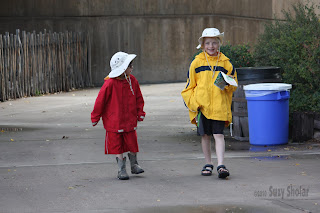
There are several photos of the boys as they walk (backwards), but I love this one where Jack is looking up to Frank.

You've got to love Photoshop Actions where you can save even a fuzzy, out of focus photo, and make it look "aged" or intentional! Thanks again Pioneer Woman for your amazing (free) Action Sets! This photo has the "Heartland" Action, from Set 2, applied to it.
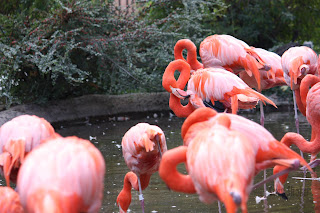
Ever since the 6th Grade I've been interested by Flamingoes.
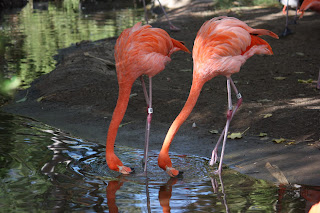
Just because I had knobby knees, weighed under 60 pounds, and wore hot pink all the time, that wouldn't have had *anything* to do with said "interest".

No matter the reason why, I do like flamingos and am quite pleased that the exhibit at this zoo is front and center by the entrance/exit. I can stop and watch them coming AND going.
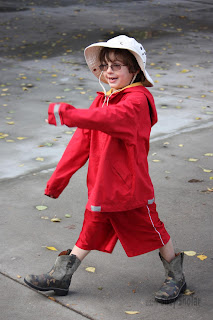
For the times when Mom is taking too many pictures, the boys get going on their own with a "C'mon MOM!"
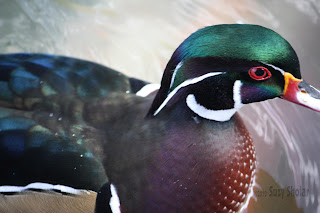
Like water on a (Carolina Wood) Duck's back, I tell you!
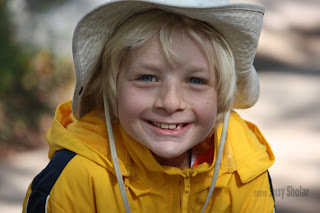
Now THIS is the kind of Birthday Portrait I've been after for the past two weeks... well, minus the raincoat and sun hat, but this expression! That's what I'm talkin' about!!!
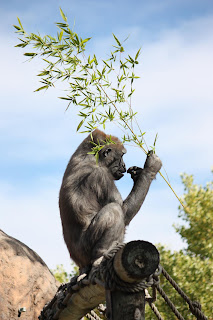
Got sun, just add tree branch.
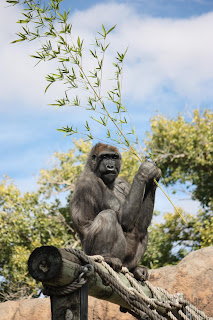
Instant shade AND a snack all in one!
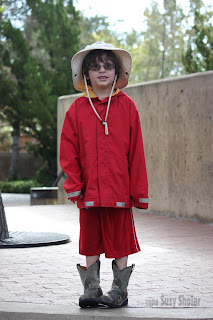
Such a funny expression and pose.


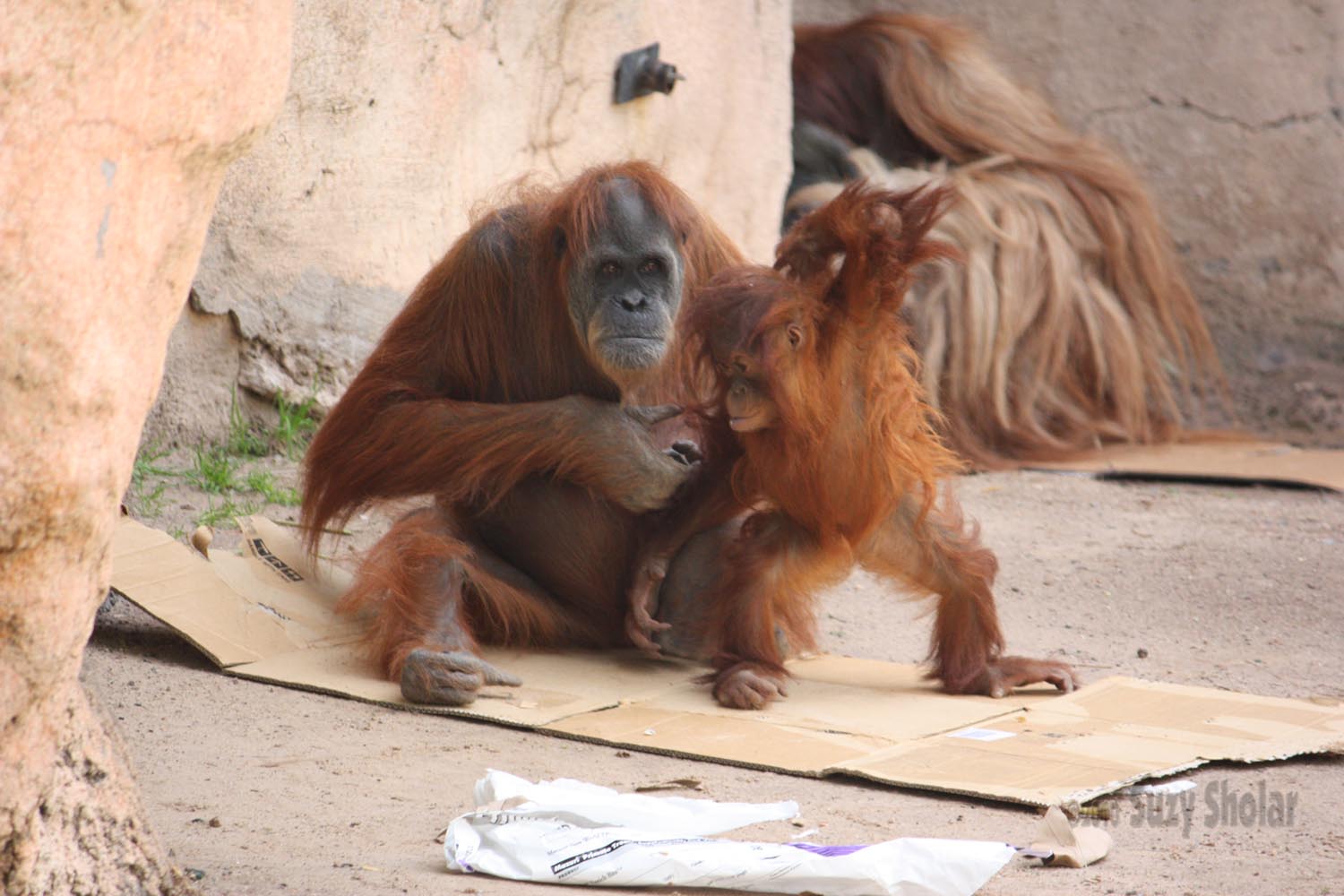
The orangutans are given cardboard and paper; which they play with, sit on, and eat (not necessarily in that order).
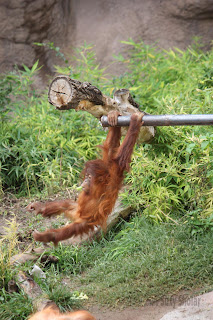
The exuberant young'en reminds me of my own...
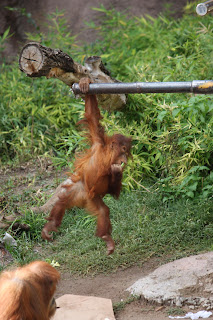
Right down to monkeying (pun DEFINITELY intended) around during meal times!

Another shot showing how the little guy looks up to the big one.

There is a small Parakeet aviary at this zoo (we've been finding many new areas during our weekly excursions).
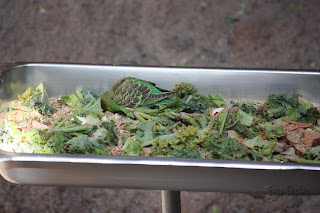
Ever wonder why there are so many green parakeets? Natural camouflage, baby!

You knew that Koala's are nocturnal, right?
You knew that Koala's are from The Land Down Under (Australia), right?
You knew that Koala's are marsupials (carry their young in pouches), right?
You know that Koala's hardly drink any water because they live by eating Eucalyptus, right?
DID YOU KNOW, that Koala's have five digits on each limb, but on their arms, they have three fingers and TWO THUMBS? Neither did we... until today!
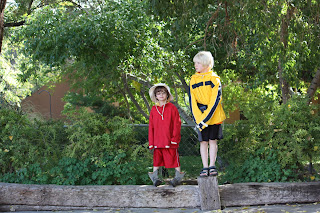
I think Jack actually has a hard time holding a "normal" pose for a photo!
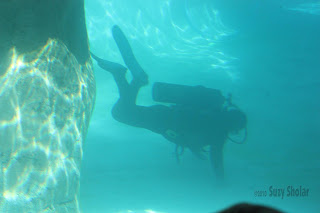
Just yesterday, Tom was telling the boys about his SCUBA diving days. The boys were delighted to watch the workers cleaning the Seal & Sea Lion Tank today.
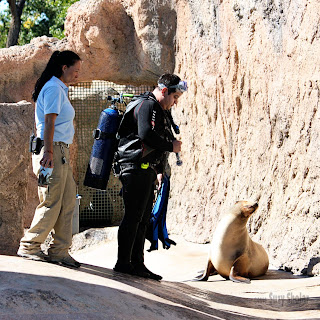
Actually, they wouldn't leave the area until the three SCUBA diver's exited the exhibit!

When I tickle Jack JUST before the camera goes off... then things look more natural!

And THAT was our third visit to this zoo. We are finally getting our groove on for what to take, how long to go, and how to relax and enjoy ourselves while there (which I am learning from the boys!)